Riding the Cumbres and Toltec ~ September 29, 2023
What a glorious day we had today!
We woke early and had a quick and easy breakfast in our Little Rock House. Jeff enjoyed a bowl of "inferior" raisin bran (he is a confessed raisin bran snob, and if it isn't Post Raisin Bran, it's "inferior"), and I enjoyed just one cup of coffee before Jeff rushed us out of the house and down to the station. I went to pick up our tickets and sit in the ticket office in my favorite rocking chair while Jeff took many of the same pictures he took yesterday of the locomotive taking on water and other such things.
 I had a lovely chat with a woman in her late 70s and what appeared to be her older sister. They live in El Paso, Texas, and were in Chama just for the day and overnight to ride the train. The older sister was a bit mobility impaired, but she downplayed it while she spoke with the docent. I suggested that they investigate the accommodations, which turned out to be a ramp that they placed in the middle of the train to enable folks who might have difficulty climbing the relatively steep steps. Once aboard, they can easily walk to their assigned car. It worked like a charm for them.
We boarded the train in Chama behind engine number 484 - the same engine we chased yesterday!
I had a lovely chat with a woman in her late 70s and what appeared to be her older sister. They live in El Paso, Texas, and were in Chama just for the day and overnight to ride the train. The older sister was a bit mobility impaired, but she downplayed it while she spoke with the docent. I suggested that they investigate the accommodations, which turned out to be a ramp that they placed in the middle of the train to enable folks who might have difficulty climbing the relatively steep steps. Once aboard, they can easily walk to their assigned car. It worked like a charm for them.
We boarded the train in Chama behind engine number 484 - the same engine we chased yesterday!

Once again, I sprang for parlor car seats, entitling us to special service that includes coffee, tea, soft drinks, and a snack in both the morning and afternoon. We enjoyed grapes over a bed of watermelon and some sort of berry pastry with our morning coffee/tea. They also give you a bag - this year, it was a string backpack - and some other memorabilia, such as a coffee mug or an insulated cup. This year's gift was a Christmas ornament.


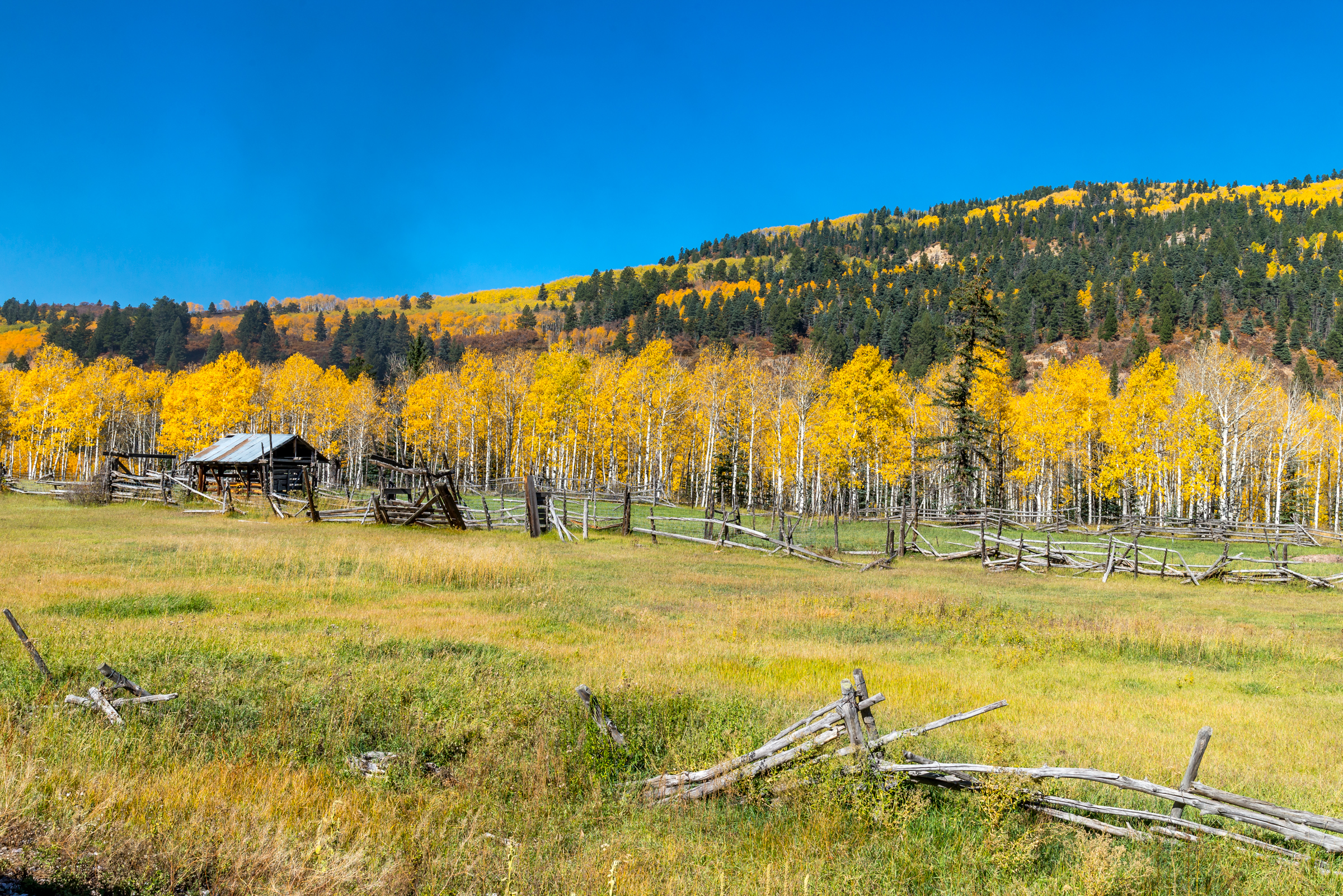
We rumbled away from the yard and across the Rio Chama. Yesterday, Jeff scrambled down an embankment to take a photo of the train at this spot. And then we began our long climb up to Cumbres Pass. It's a four percent grade - for every hundred feet we go, we gain four feet in altitude - from the yard to Cumbres Pass. The first of many landmarks along the route came a bit more than four miles into our journey at a remnant of the historic Lobato sheep ranch. The rolling meadows host the Lobato Trestle that spans the rushing Wolf Creek below. Thin, white aspen trees with shimmering leaves line the grassy hills. Lobato has little left, just some dilapidated fencing and an even more dilapidated cabin. But it is very picturesque, surrounded by the beauty of pine and aspen-studded hillsides. There is a partial water tower and Lobato Trestle, which was designed by Charles Shaler Smith, manufactured by the Keystone Bridge Company, and erected on the site in 1883. It replaced a three-year-old temporary wooden trestle that had been part of the route's original construction. The trestle is 340 feet long and 100 feet off the canyon floor at the highest point.
 As the train climbs ever higher, we can look back and see the entire Chama Valley. The train climbs higher and higher, and we can hear and feel the locomotive working its hardest to pull the train up to Cumbres Pass. Along the way, we pass Cresco Tank, a wooden gravity-fed water tank used to provide the train with water to generate steam. We don't stop as the tank is no longer in daily service.
The train hugs a sheer rock face as we round Windy Point, where the rails are laid on a rock shelf that has been carved out of the face of the cliff.
 Finally, we reach the summit, where there are alpine meadows sprinkled with wildflowers. The aspens have given way to tall, dark green conifers that frame the spectacular vistas. It is noticeably cooler up here at the highest point on the railroad - 10,015 feet above sea level.
 Railroad families used to live up here, but now it is a display place with a section house and some of the buildings used by the railroad families of yore. The Friends of the Cumbres and Toltec host work parties every summer, and they have been working to restore these buildings for several years now.
We stopped briefly at Cumbres Pass to take on some water and to check the brakes. In years past, we were able to get off the train, but not so on this trip. Soon enough, we are off heading down into the Chama Valley around Tanglefoot Curve, a loop so tight that it almost seems the locomotive will meet the caboose. I took this picture from my seat in the Parlor Car - the last car on the train!
Railroad families used to live up here, but now it is a display place with a section house and some of the buildings used by the railroad families of yore. The Friends of the Cumbres and Toltec host work parties every summer, and they have been working to restore these buildings for several years now.
We stopped briefly at Cumbres Pass to take on some water and to check the brakes. In years past, we were able to get off the train, but not so on this trip. Soon enough, we are off heading down into the Chama Valley around Tanglefoot Curve, a loop so tight that it almost seems the locomotive will meet the caboose. I took this picture from my seat in the Parlor Car - the last car on the train!
 At Tanglefoot Curve, train crews would jump off the slow-moving trains on the upper track to inspect the trains for "hot boxes" (burned-out bearings) and then reboard the caboose. The legend is that Tanglefoot Curve got its name from a trainman who tangled his foot in a brier of some sort and slid down the bank almost into the path of his own train!
We continued to make our way to Osier, crossing Cascade Trestle, the highest bridge on the Cumbres and Toltec, 137 feet above Cascade Creek. This trestle was also built by Keystone Bridge Company around 1889.
At Tanglefoot Curve, train crews would jump off the slow-moving trains on the upper track to inspect the trains for "hot boxes" (burned-out bearings) and then reboard the caboose. The legend is that Tanglefoot Curve got its name from a trainman who tangled his foot in a brier of some sort and slid down the bank almost into the path of his own train!
We continued to make our way to Osier, crossing Cascade Trestle, the highest bridge on the Cumbres and Toltec, 137 feet above Cascade Creek. This trestle was also built by Keystone Bridge Company around 1889.
 At Osier, we got off the train and went into a large building for lunch. It's a served buffet, and all hundred and eighty passengers queue up in two lines where you can have as much as you want of things like rice, potatoes, chicken, meatloaf, enchiladas (very spicy), and a variety of salads. In years past, they would cook a full turkey dinner, but it appears that it is under new management. We found it to be quite delicious.
Osier, Colorado, was a toll station from Conejos to Chama on the road. There are several original structures at Osier, including the depot built in 1880, which once had a platform, and the section house that was built in 1884. There was a bunk house, a coal house, and a Keystone turntable covered by a snowshed. The turntable was retired in 1927. There is also a water tank that was built in 1880 and some cattle pens. As we enjoyed our lunch, Jeff glanced out the window to see a group of five prairie dogs basking in the sun. I think he took some photos, which I will add when we get home (if I remember to do so). It was fun to watch them.
After lunch, we boarded our train for the trip down the mountain into Antonito. We swapped engines with the train heading from Antonito to Chama, so the second half of our journey was pulled by engine number 463.
At Osier, we got off the train and went into a large building for lunch. It's a served buffet, and all hundred and eighty passengers queue up in two lines where you can have as much as you want of things like rice, potatoes, chicken, meatloaf, enchiladas (very spicy), and a variety of salads. In years past, they would cook a full turkey dinner, but it appears that it is under new management. We found it to be quite delicious.
Osier, Colorado, was a toll station from Conejos to Chama on the road. There are several original structures at Osier, including the depot built in 1880, which once had a platform, and the section house that was built in 1884. There was a bunk house, a coal house, and a Keystone turntable covered by a snowshed. The turntable was retired in 1927. There is also a water tank that was built in 1880 and some cattle pens. As we enjoyed our lunch, Jeff glanced out the window to see a group of five prairie dogs basking in the sun. I think he took some photos, which I will add when we get home (if I remember to do so). It was fun to watch them.
After lunch, we boarded our train for the trip down the mountain into Antonito. We swapped engines with the train heading from Antonito to Chama, so the second half of our journey was pulled by engine number 463.
 I had forgotten that the first half of this part of the journey was incredibly beautiful! It took us through two tunnels adjacent to the spectacular Toltec Gorge.

 This monument to President James A. Garfield was erected by railroad ticket agents in his memory after he was assassinated in 1881. I haven't been able to find out why they decided to build it.
Almost immediately after viewing the monument, we entered Rock Tunnel, a 360-foot tunnel bored through solid rock. We rounded Phantom Curve, named for the ghostly shapes and shadows seen in the engine's headlight at night and through Mud Tunnel. Mud Tunnel is supported by wooden beams for all of its 342-foot length. Our car hostess told us that in the 1920s, the tunnel collapsed as the engine entered the tunnel, killing the engineer. Passengers waited while another train came up from Antonito carrying horses and mules to rescue them. They were ferried on horseback around the tunnel and into passenger cars on the awaiting train.
The view of Toltec Gorge cannot be captured in a photograph, but here's my feeble attempt.
This monument to President James A. Garfield was erected by railroad ticket agents in his memory after he was assassinated in 1881. I haven't been able to find out why they decided to build it.
Almost immediately after viewing the monument, we entered Rock Tunnel, a 360-foot tunnel bored through solid rock. We rounded Phantom Curve, named for the ghostly shapes and shadows seen in the engine's headlight at night and through Mud Tunnel. Mud Tunnel is supported by wooden beams for all of its 342-foot length. Our car hostess told us that in the 1920s, the tunnel collapsed as the engine entered the tunnel, killing the engineer. Passengers waited while another train came up from Antonito carrying horses and mules to rescue them. They were ferried on horseback around the tunnel and into passenger cars on the awaiting train.
The view of Toltec Gorge cannot be captured in a photograph, but here's my feeble attempt.
 From there, we passed Sublette, a small settlement that was home to the section gangs who maintained the right of way, ties, ballast, and rails. There is a bunkhouse, coal storage, water spout, and a speeder shed there.
 The train meanders through the valley, and before long, we find ourselves in the desert with vistas of sagebrush and the occasional sighting of antelope. For me, this was the boring part of the trip, and I was glad when we arrived in Antonito, where motorcoaches waited to take us back to Chama - a 45-minute or so ride. Tired after a long day, we returned to the Rock House just before 7 p.m. I fixed a dinner of grilled chicken, rice, and green beans, and we enjoyed some quiet time together. But now it's time for some sleep!
 |
| Cresco Tank |


Comments
Post a Comment